SABIS-CHEMISTRY.COM · MR. HISHAM MAHMOUD
Official AP Course Companion

🖨️ PRINT THIS GUIDE & KEEP IT IN YOUR AP CHEMISTRY BINDER!

What is this guide? This is your official study, homework walkthrough, and exam revision guide for Topic 1.5 (Atomic Structure & Electron Configurations). Print this full packet now, hole-punch it, and file it into your 3-ring binder under Unit 1. Refer to it during daily study, homework walkthroughs, and exam review!

📥 Download Official 28-Page Companion PDF (Vector Print-Ready) Exact 28 pages · Matches 3-Ring Binder & Table of Contents
[ ] 5   [ ] 4   [ ] 3

🚦 Prerequisite Knowledge Self-Check (Are You Ready for Topic 1.5?)

Read each question honestly before beginning Topic 1.5. If you have any doubt, flip straight to the Annex page indicated at the end of this packet.

# Prerequisite Skill & Diagnostic Question Confidence Action If In Doubt
1 Cations vs. Anions: Do you remember how charges form (losing vs. gaining electrons) and why atoms ionize? ✅ Know   ⚠️ Review → Annex Page 23
2 Subatomic Particles (⁵⁶₂₆Fe): Can you immediately state protons (26), neutrons (30), and electrons (26)? ✅ Know   ⚠️ Review → Annex Page 24
3 Coulomb's Law: Do you know how charge magnitude and distance dictate electrostatic attraction? ✅ Know   ⚠️ Review → Annex Page 25
4 Bohr Shells & Shielding: Can you distinguish outer valence electrons from inner shielding core electrons? ✅ Know   ⚠️ Review → Annex Page 26
5 Criss-Cross Ionic Formulas: If element X forms X³⁻, can you write Mg₃X₂ when combined with Mg²⁺? ✅ Know   ⚠️ Review → Annex Page 27
6 Periodic Geography: Can you locate alkali metals, halogens, and noble gases with their charges? ✅ Know   ⚠️ Review → Annex Page 28
⚡ What is a Cation?
Positively charged ion (lost e⁻, e.g., Na → Na⁺ + e⁻).
Memory Trick: The letter "t" in *cation* looks like a + sign!
⚡ What is an Anion?
Negatively charged ion (gained e⁻, e.g., Cl + e⁻ → Cl⁻).
Memory Trick: A Negative Ion = ANIon!
SABIS-CHEMISTRY.COM · MR. HISHAM MAHMOUD

Guide Index & Table of Contents

Complete 28-page roadmap: 8 Concept Subsections, 8 Homework Models, and 6 Prerequisite Refreshers.

PART 1: CORE CONCEPT NOTES (PAGES 3–10)
Section 1.5.1: Subatomic Particles & Isotopes (ᴬ_Z X)3
Section 1.5.2: Architecture of Atom (s, p, d, f Orbitals)4
Section 1.5.3: Three Quantum Rules (Aufbau, Hund, Pauli)5
Section 1.5.4: Ground State vs. Excited State vs. Violations6
Section 1.5.5: Ion Configurations & Transition Metal FIFO7
Section 1.5.6: Isoelectronic Series & Ionic Radii Trends8
Section 1.5.7: Coulomb's Law & First Ionization Energy9
Section 1.5.8: Predicting Ionic Formulas (Mg₃X₂)10
PART 2: 8 HOMEWORK MODELS (PAGES 11–19)
Model 1: Counting Subatomic Particles in ⁵⁶₂₆Fe11
Model 2: Identifying True Isotopic Pairs (³⁵Cl / ³⁷Cl)12
Model 3: Ground-State Configuration of F⁻ Anion13
Model 4: Identifying Isoelectronic Species for Br⁻14
Model 5: Valence States & Predicting Mg₃X₂ Formula15
Model 6: Comparing First Ionization Energy Trends16
Model 7: Detecting Excited-State Configurations17
Model 8: Explaining Why F⁻ is Smaller than O²⁻18
Summary: Diagnostic AP Exam Errors & Traps19
PARTS 3 & 4: MASTERY AUDIT (PAGES 20–21)
Part 3: Student Subtopic Mastery Checklist20
Part 4: Student Misconception Vault & Reflection21
ANNEXES: VISUALS & REFRESHERS (PAGES 22–28)
Visual Annex: Aufbau, Potential Well & Radii Charts22
Annex A: Cations vs. Anions (Charge & Octets)23
Annex B: Subatomic Particle Accounting (ᴬ_Z X)24
Annex C: Coulomb's Law Fundamentals (F ∝ q₁q₂/r²)25
Annex D: Bohr Shells & Shielding (Z_eff = Z - S)26
Annex E: Balancing Ionic Compounds (Criss-Cross)27
Annex F: Periodic Table Geography & Families28
💡 How to Navigate: Every homework question in Part 2 is directly explained in the matching Section 1.5.X notes on pages 3–10. If you need foundational review, turn to Annexes A–F on pages 22–28.
SABIS-CHEMISTRY.COM · MR. HISHAM MAHMOUD

Section 1.5.1: Subatomic Particles, Nuclide Symbols & Isotopes

Every atom is composed of three fundamental particles: protons, neutrons, and electrons.

ParticleSymbolMassChargeLocationRole in Chemical Behavior
Protonp⁺≈ 1 amu+1NucleusDefines atomic number (Z) and element identity.
Neutronn⁰≈ 1 amu0NucleusNuclear stability and mass. Varies between isotopes.
Electrone⁻≈ 0 amu-1CloudResponsible for chemical bonds, valence, and ions.

1. The Standard Nuclide Symbol Format: ᴬ_Z X^charge

2. What Exactly Are Isotopes?

Isotopes are atoms of the same element (same atomic number Z) that have different numbers of neutrons (different mass numbers A). Because isotopes have identical electron configurations, they exhibit identical chemical reactivity, but differ in mass-dependent physical properties (density, effusion rate).

Concrete Worked Example

Accounting for Particles in ⁵⁶₂₆Fe

• Protons: Z = 26 protons (defines Iron).

• Neutrons: A - Z = 56 - 26 = 30 neutrons.

• Electrons: Neutral atom → electrons = protons = 26 electrons.

AP Exam Trap: Never confuse mass number (A) with atomic mass! Mass number is an integer for a single nucleus (56 for ⁵⁶Fe); atomic mass is a weighted average decimal on the periodic table (55.85 amu).
SABIS-CHEMISTRY.COM · MR. HISHAM MAHMOUD

Section 1.5.2: Architecture of the Atom (Shells, Subshells & Orbitals)

The electron cloud is organized into Principal Energy Levels (n), Subshells (s, p, d, f), and Orbitals.
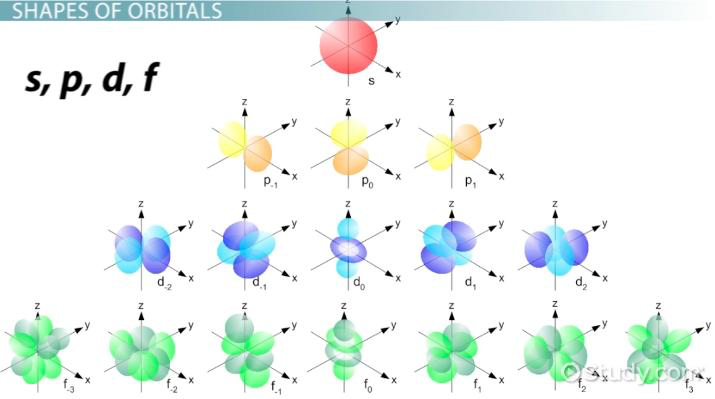
Shapes of Orbitals s, p, d, f
🚨 AP Exam Scope Requirement:
ONLY s and p orbital shapes are required for the AP Chemistry Exam!
• s-orbital: Spherically symmetrical boundary surface.
• p-orbitals: Dumbbell shape with two lobes oriented along the 3D axes (px, py, pz).
• d and f orbitals: You only need to know their electron capacities (d holds 10 e⁻, f holds 14 e⁻). Sketching or identifying complex d or f spatial lobes is NOT tested on the AP Exam.

Subshell Capacity Breakdown Table

Subshell Geometric Description Number of Orbitals Max Electrons First Appears
s Spherical symmetry 1 orbital 2 e⁻ n = 1 (1s)
p Dumbbell (px, py, pz) 3 orbitals 6 e⁻ n = 2 (2p)
d Four-leaf clover / donut 5 orbitals 10 e⁻ n = 3 (3d)
f Complex multi-lobed 7 orbitals 14 e⁻ n = 4 (4f)

Principal Shell Capacity (2n² Formula)

Level n = 1: 1s²Capacity = 2 electrons (2 × 1²)
Level n = 2: 2s² 2p⁶Capacity = 8 electrons (2 × 2²)
Level n = 3: 3s² 3p⁶ 3d¹⁰Capacity = 18 electrons (2 × 3²)
Level n = 4: 4s² 4p⁶ 4d¹⁰ 4f¹⁴Capacity = 32 electrons (2 × 4²)
SABIS-CHEMISTRY.COM · MR. HISHAM MAHMOUD

Section 1.5.3: The Three Fundamental Quantum Rules

Writing any ground-state electron configuration requires obeying three non-negotiable rules:

1. The Aufbau Principle ("Building Up")

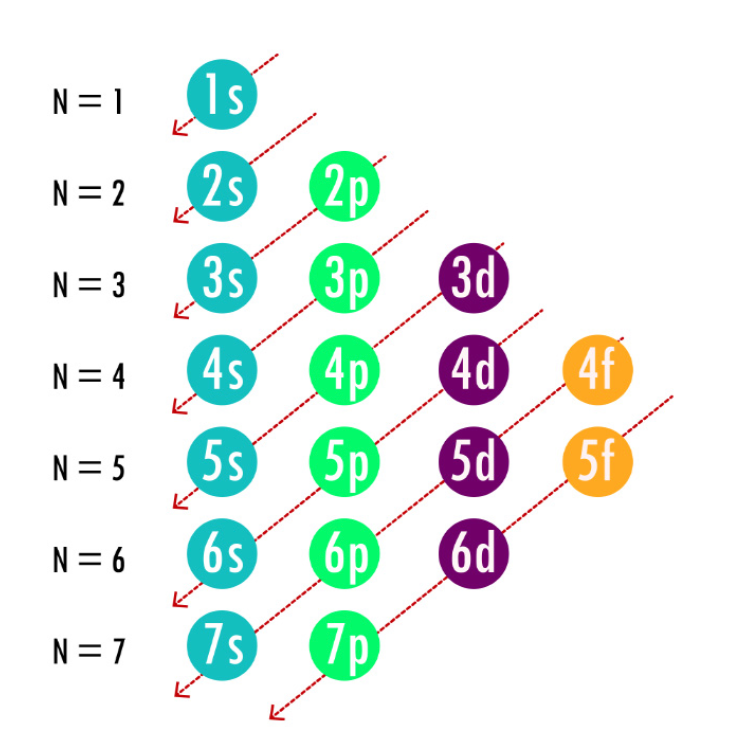
Electrons occupy the lowest available energy orbital first: 1s → 2s → 2p → 3s → 3p → 4s → 3d...

2. Hund's Rule ("The Bus Seat Rule")

When filling degenerate orbitals (orbitals of equal energy, like the three 2p orbitals), electrons occupy them singly with parallel spins before pairing up to minimize electron repulsion.

3. The Pauli Exclusion Principle

An orbital can hold at most two electrons, and they must have opposite spins (↑↓).

Visual Comparison: Professional Orbital Box Filling

Element Subshell Correct Ground State (Hund's Rule) Common Violation / Error
Carbon (Z=6) 2p²
↑
↑
✅ Correct
↑↓
❌ Hund's Violation
Nitrogen (Z=7) 2p³
↑
↑
↑
✅ 3 Half-Filled
↑↓
↑
❌ Premature Pairing
Oxygen (Z=8) 2p⁴
↑↓
↑
↑
✅ Paired 1st Box
↑↑
↑
↑
❌ Pauli Violation
SABIS-CHEMISTRY.COM · MR. HISHAM MAHMOUD

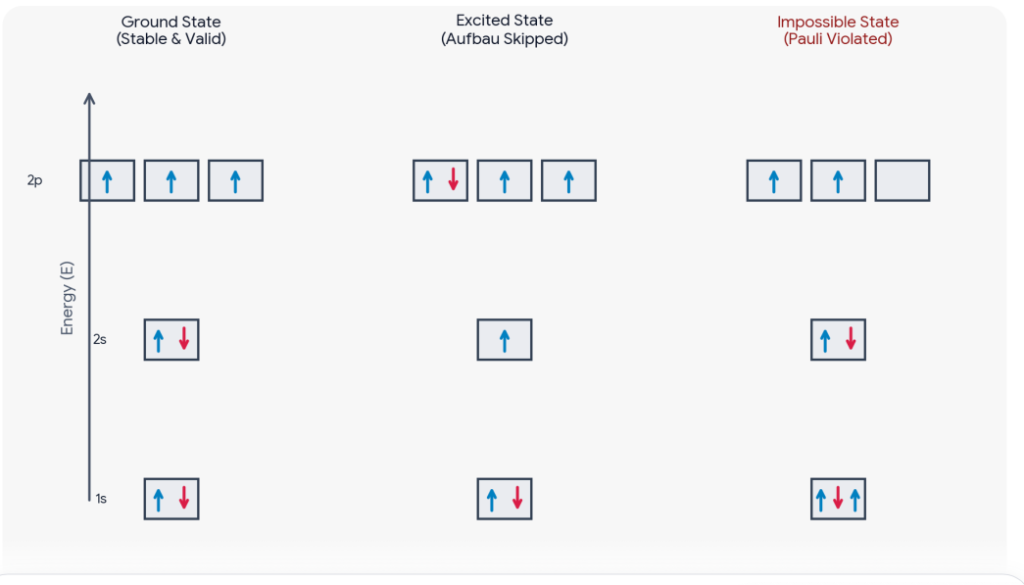
Section 1.5.4: Ground State vs. Excited State vs. Impossible Violations

How to classify any electron configuration on the AP Chemistry Exam:

Ground State vs Excited State vs Impossible State
ClassificationDefinitionElectron Count & Rule Check
Ground StateLowest energy arrangement.Obeys Aufbau, Hund, and Pauli completely.
Excited StateElectron absorbed energy and jumped up.Aufbau skipped, BUT subshell capacities (s≤2, p≤6, d≤10) respected!
ImpossibleViolates quantum physics.Subshell overfilled (e.g. 1s³) or wrong spin pairing in same orbital!

The 3-Step Decision Highway (AP Exam Checklist)

Step 1: Sum superscriptsMust equal atomic number Z (neutral) or ion electron count.
Step 2: Check orbital limits (s≤2, p≤6, d≤10)If exceeded (e.g. 1s³ or 2p⁷), IMPOSSIBLE VIOLATION!
Step 3: Check Aufbau energy orderingIf a lower orbital has empty spots while higher is filled, EXCITED!
SABIS-CHEMISTRY.COM · MR. HISHAM MAHMOUD

Section 1.5.5: Electron Configurations of Ions & Transition Metal Exceptions

1. Anions (Gain e⁻): Fill lowest open valence orbital to reach octet (e.g. F: 2p⁵ + 1e⁻ → F⁻: 2p⁶).
2. Main-Group Cations (Lose e⁻): Outermost s-electrons lost first (e.g. Mg: [Ne] 3s² → Mg²⁺: [Ne]).
🚨 THE TRANSITION METAL "FIRST IN, FIRST OUT" (FIFO) RULE:
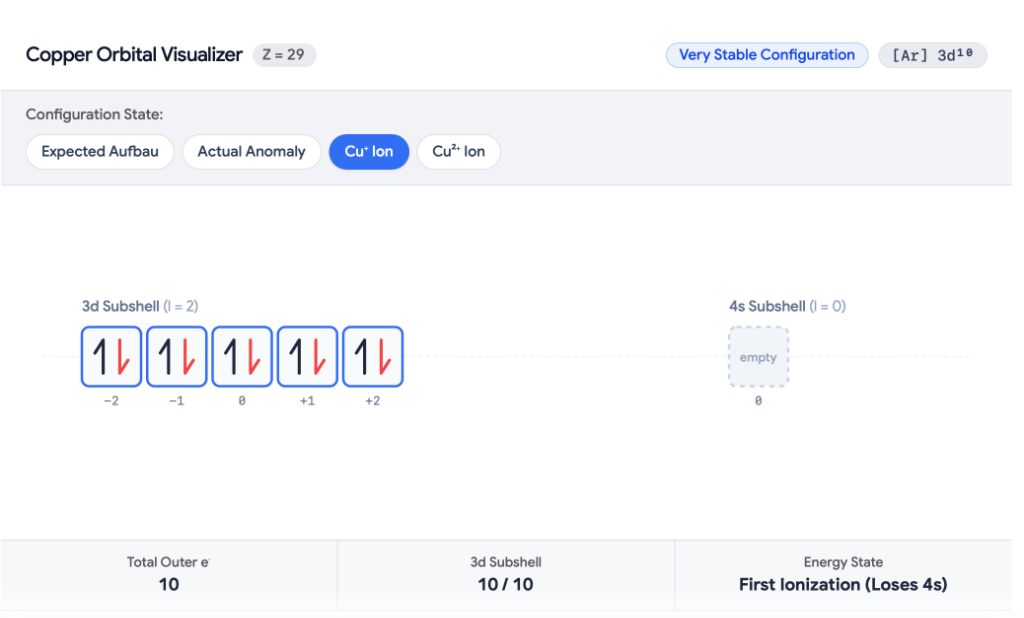
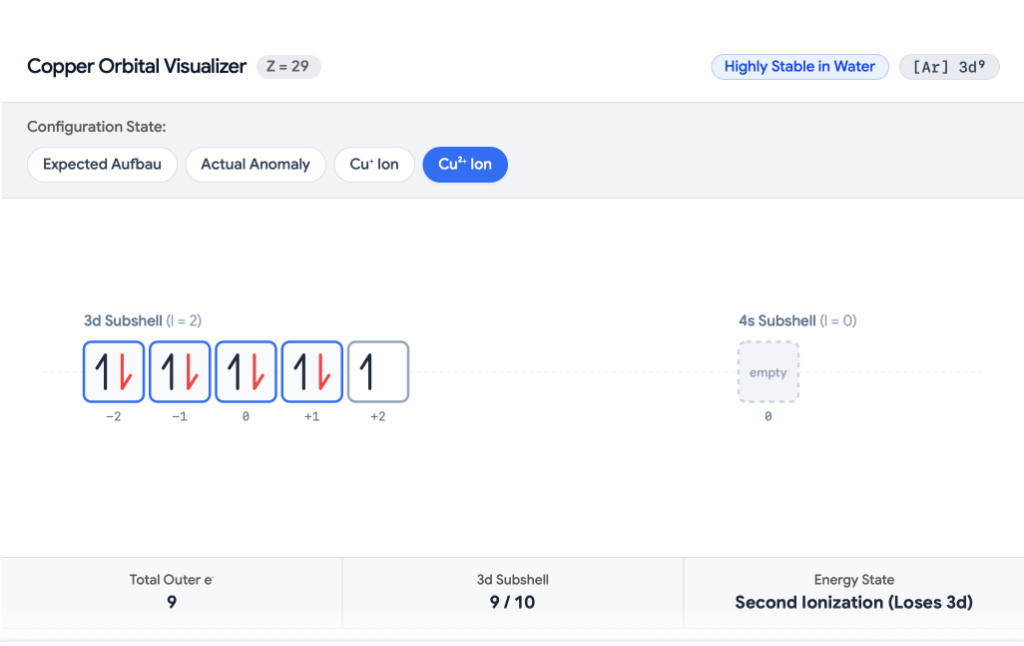
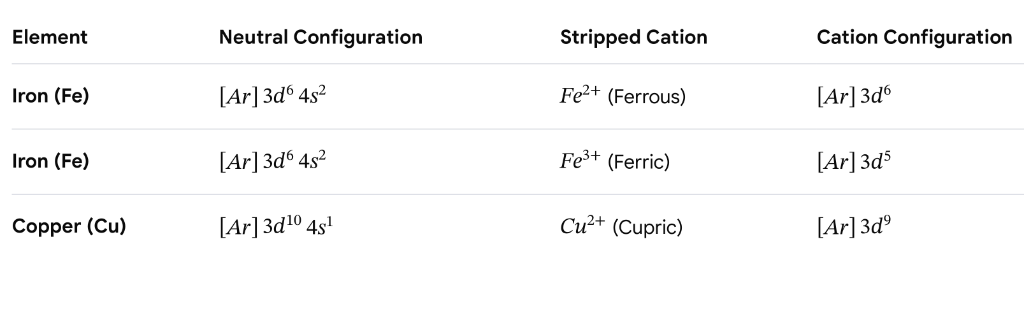
In neutral atoms, 4s fills before 3d. When forming cations, electrons are ALWAYS removed from 4s FIRST before 3d!

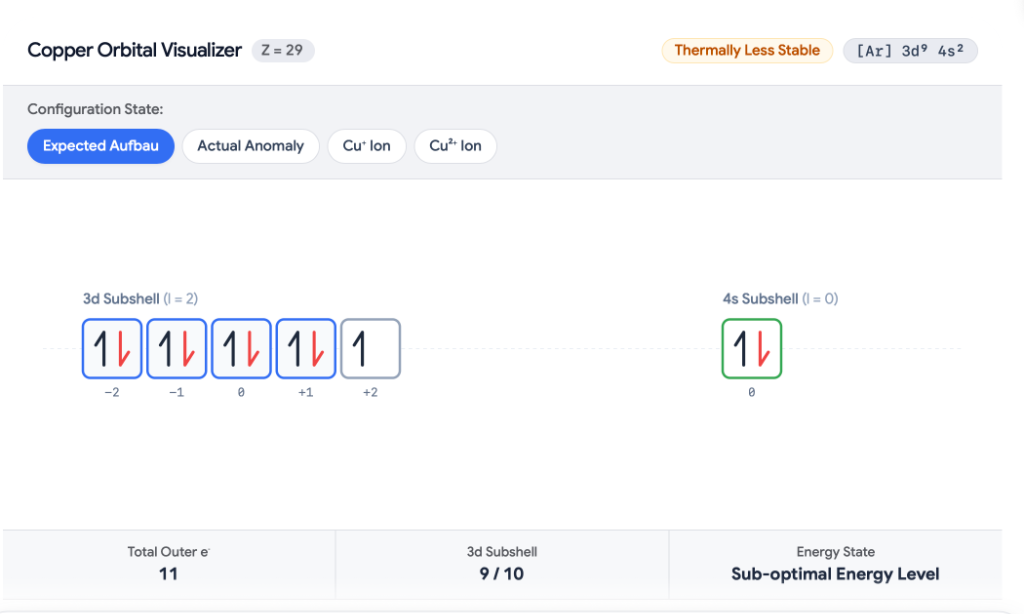
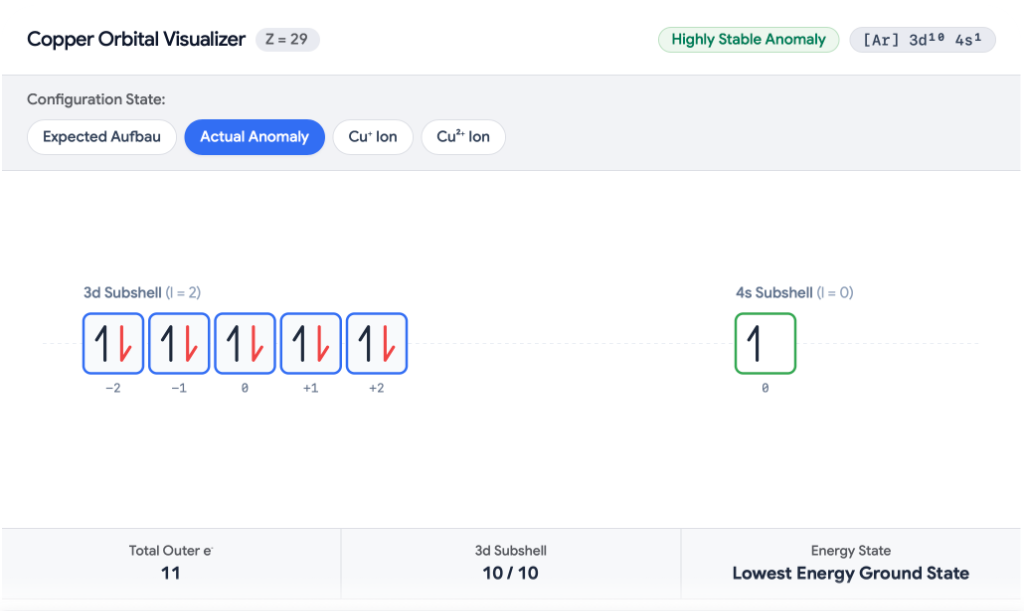
Visual Deep-Dive: The Copper (Cu, Z = 29) Orbital Visualizer

Follow the 4 distinct stages of Copper from expected Aufbau to actual ground-state anomaly and sequential ionization:

Copper Expected Aufbau 3d9 4s2
Copper Actual Anomaly 3d10 4s1
Cu+ Ion 3d10 (Loses 4s)
Cu2+ Ion 3d9 (Loses 3d)
Transition Metal Configurations: Neutral vs Cations
SABIS-CHEMISTRY.COM · MR. HISHAM MAHMOUD

Section 1.5.6: Isoelectronic Series & Ionic Radii

An isoelectronic series is a group of species having the exact same number of electrons (same configuration).

Visual Comparison Drawing: 10-Electron Series (1s² 2s² 2p⁶)

Notice how increasing nuclear charge (more protons) contracts the electron cloud:

N³⁻
7 Protons
146 pm
O²⁻
8 Protons
140 pm
F⁻
9 Protons
133 pm
Na⁺
11 Protons
102 pm
Mg²⁺
12 Protons
72 pm
Al³⁺
13 Protons
54 pm

The Official AP Justification Template

Why is F⁻ smaller than O²⁻?
1. Both F⁻ and O²⁻ are isoelectronic with 10 electrons in the n = 2 shell (identical shielding).
2. Fluorine has 9 protons (Z = +9), while oxygen has only 8 protons (Z = +8).
3. By Coulomb's Law, the greater nuclear charge in F⁻ exerts a stronger electrostatic attraction, pulling the cloud tighter and resulting in a smaller radius.
SABIS-CHEMISTRY.COM · MR. HISHAM MAHMOUD

Section 1.5.7: Coulomb's Law & First Ionization Energy

1. Coulomb's Law Governing Periodic Trends (Vertical Ratio Form)

Force of Electrostatic Attraction ∝ q₁ × q₂ r²

• Numerator (q₁ × q₂): Charge magnitude. Higher effective nuclear charge (Z_eff) → Stronger attraction.

• Denominator (r²): Distance squared. As valence electrons enter higher shells (larger r), attraction decreases exponentially!

2. First Ionization Energy (IE₁) Trends

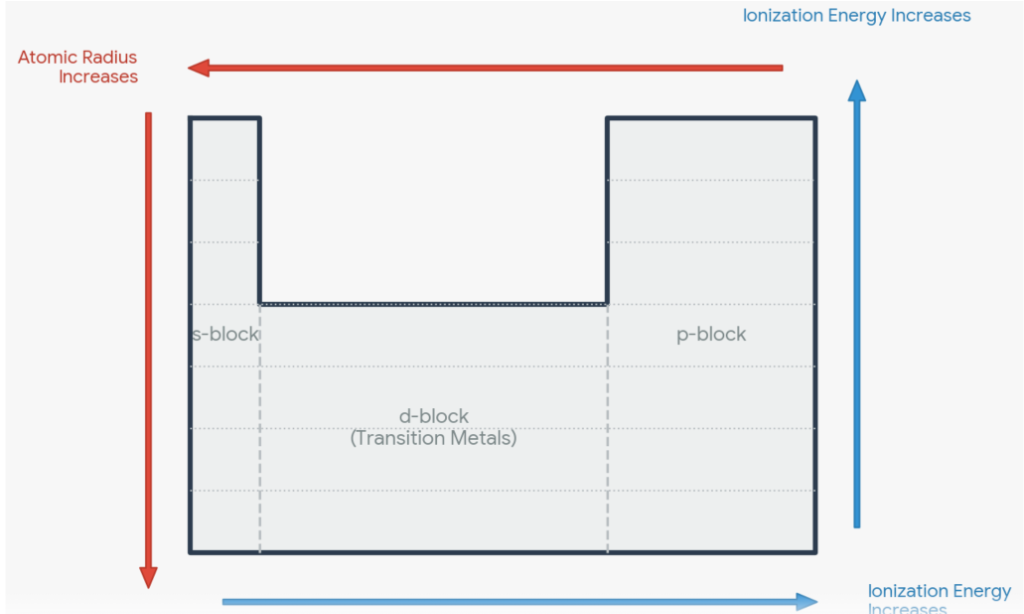
• Across a Period (Left to Right): IE₁ Generally INCREASES. Distance r is roughly constant (same shell n), but proton count Z increases. Valence electrons are held more tightly.

• Down a Group (Top to Bottom): IE₁ DECREASES. Shell n increases, placing valence electrons farther away with more inner core shielding.

Periodic Trend Arrows: Atomic Radius vs Ionization Energy

3. Periodic Anomalies (AP Exam Favorites!)

• Be > B: Boron's 2p electron is higher energy and partially shielded by 2s² electrons, requiring less energy to remove.

• N > O: Oxygen has electron-electron repulsion between paired electrons in its 2p orbital, making that electron easier to remove.

SABIS-CHEMISTRY.COM · MR. HISHAM MAHMOUD

Section 1.5.8: Predicting Ionic Formulas from Valence Configurations

1. Deducing Group & Charge from Configuration

Given element X with configuration: 1s² 2s² 2p⁶ 3s² 3p³

1. Outermost shell: n = 3.

2. Valence electrons: 3s² + 3p³ = 5 valence electrons → Group 15.

3. Stable ion: Needs 3 electrons to complete octet → forms X³⁻.

2. Combining with Magnesium (Mg) for Electrical Neutrality

• Magnesium is in Group 2 → forms Mg²⁺.

• Element X forms X³⁻.

Total Positive Charge + Total Negative Charge = 0
3 × (+2) + 2 × (-3) = (+6) + (-6) = 0
Balanced Empirical Formula:Mg₃X₂
Example Identity: Element X is phosphorus (Z = 15); the compound formed is magnesium phosphide, Mg₃P₂.
SABIS-CHEMISTRY.COM · MR. HISHAM MAHMOUD
Prepares for Homework Question 1

Model 1: Counting Subatomic Particles in ⁵⁶₂₆Fe

Scenario: How many protons, neutrons, and electrons are in an atom of Iron-56 (⁵⁶₂₆Fe)?

Step-by-Step Solution:

1. Protons: Equal to atomic number Z (lower number) → 26 protons.

2. Neutrons: Mass number minus atomic number: A - Z = 56 - 26 = 30 neutrons.

3. Electrons: Neutral atom (no charge indicated) → electrons = protons = 26 electrons.

Answer: 26 protons, 30 neutrons, 26 electrons.

Watch-Out: Never treat mass number 56 as the number of neutrons!
SABIS-CHEMISTRY.COM · MR. HISHAM MAHMOUD
Prepares for Homework Question 2

Model 2: Identifying True Pairs of Isotopes

Scenario: Which represents a true pair of isotopes? (A) ¹⁴₆C & ¹⁴₇N (B) ²³₁₁Na⁺ & ²⁴₁₁Na (C) ³⁵₁₇Cl & ³⁷₁₇Cl (D) ¹⁶₈O & ¹⁶₈O²⁻

Step-by-Step Solution:

• Criteria: Must have same atomic number Z (same element) and different mass number A (different neutrons).

• Choice C has Z = 17 for both, with A = 35 (18 neutrons) and A = 37 (20 neutrons).

Answer: (C) ³⁵₁₇Cl and ³⁷₁₇Cl.

SABIS-CHEMISTRY.COM · MR. HISHAM MAHMOUD
Prepares for Homework Question 3

Model 3: Ground-State Configuration of F⁻ Anion

Scenario: What is the ground-state electron configuration of the fluoride ion (F⁻)?

Step-by-Step Solution:

1. Neutral fluorine (Z = 9) has 9 electrons: 1s² 2s² 2p⁵.

2. The -1 charge means 1 electron is gained: 9 + 1 = 10 electrons.

3. Adding 1 electron to 2p completes the octet: 1s² 2s² 2p⁶.

Answer: 1s² 2s² 2p⁶ (isoelectronic with Neon, [Ne]).

SABIS-CHEMISTRY.COM · MR. HISHAM MAHMOUD
Prepares for Homework Question 4

Model 4: Determining Isoelectronic Species for Br⁻

Scenario: Which of the following ions has the same number of electrons as Br⁻? (A) Cl⁻ (B) Se²⁻ (C) K⁺ (D) I⁻

Step-by-Step Solution:

1. Bromide (Br⁻): Z = 35, gained 1 e⁻ → 36 electrons (Krypton core).

2. Selenium (Se, Z = 34): Se²⁻ gained 2 e⁻ → 34 + 2 = 36 electrons.

Answer: (B) Se²⁻.

SABIS-CHEMISTRY.COM · MR. HISHAM MAHMOUD
Prepares for Homework Question 5

Model 5: Valence Configurations & Predicting Mg₃X₂

Scenario: Element X has configuration 1s² 2s² 2p⁶ 3s² 3p³. What compound does it form with magnesium?

Step-by-Step Solution:

1. Element X has 5 valence electrons (3s² 3p³) → gains 3 e⁻ to form X³⁻.

2. Magnesium (Group 2) forms Mg²⁺.

3. Criss-cross for neutrality: 3 × (+2) + 2 × (-3) = 0 → Mg₃X₂.

Answer: Mg₃X₂.

SABIS-CHEMISTRY.COM · MR. HISHAM MAHMOUD
Prepares for Homework Question 6

Model 6: Greatest First Ionization Energy

Scenario: Which configuration has the greatest first ionization energy? (A) [Ne] 3s¹ (B) [Ne] 3s² 3p² (C) [Ne] 3s² 3p⁶ (D) [Ar] 4s¹

Step-by-Step Solution:

• Configuration C is Argon, a noble gas with a closed shell octet (3s² 3p⁶).

• It has the highest effective nuclear charge (Z_eff) in Period 3 and holds its electrons most tightly.

Answer: (C) 1s² 2s² 2p⁶ 3s² 3p⁶.

SABIS-CHEMISTRY.COM · MR. HISHAM MAHMOUD
Prepares for Homework Question 7

Model 7: Detecting Excited-State Configurations

Scenario: Which represents an excited state? (A) 1s² 2s² 2p⁶ 3s² (B) 1s² 2s² 2p⁵ 3s¹ (C) 1s² 2s² 2p⁷ (D) 1s² 2s² 2d⁴

Step-by-Step Solution:

• In B, total electrons = 10 (Neon). An electron from 2p jumped to 3s. Capacities are respected.

• C is impossible (2p cannot hold 7 e⁻); D is impossible (no 2d orbital).

Answer: (B) 1s² 2s² 2p⁵ 3s¹.

SABIS-CHEMISTRY.COM · MR. HISHAM MAHMOUD
Prepares for Homework Question 8

Model 8: Explaining Why F⁻ is Smaller than O²⁻

Scenario: Which best accounts for F⁻ being smaller than O²⁻?

Step-by-Step Solution:

1. Both ions have 10 electrons (isoelectronic) and identical shielding.

2. Fluorine has 9 protons; Oxygen has 8 protons.

3. Greater nuclear charge pulls the electron cloud closer.

Answer: (B) F⁻ has a larger nuclear charge (more protons) than O²⁻.

SABIS-CHEMISTRY.COM · MR. HISHAM MAHMOUD

Diagnostic Matrix of AP Exam Errors & Traps

Common ErrorWhy Students Make ItCorrect AP Principle
Removing 3d before 4s in cations4s filled first in neutral atom.4s electrons are farthest out and always lost first.
Thinking F⁻ is smaller due to fewer electronsForgot both ions have 10 e⁻.F⁻ is smaller because it has more protons (9 vs 8).
Calling 2p⁷ an excited stateAssumed weird means excited.Subshell capacities cannot be exceeded; 2p⁷ is impossible.
Confusing Mass # with Atomic MassSaw decimal on periodic table.Mass number is an integer for one nucleus; decimal is average.
SABIS-CHEMISTRY.COM · MR. HISHAM MAHMOUD

Part 3: Student Subtopic Mastery Checklist

Audit your mastery before quizzes or unit exams:

Target SkillRef.I Got This!Need Review
1. Count subatomic particles from nuclide notation ᴬ_Z X.p. 3[ ][ ]
2. Distinguish isotopes from isobars and ions.p. 3, 12[ ][ ]
3. State orbital capacities for s, p, d, f subshells.p. 4[ ][ ]
4. Apply Aufbau, Hund's Rule, and Pauli Exclusion.p. 5[ ][ ]
5. Identify ground, excited, and impossible states.p. 6, 17[ ][ ]
6. Write electron configurations of anions and cations (FIFO).p. 7[ ][ ]
7. Compare isoelectronic species using Coulomb's Law.p. 8, 18[ ][ ]
8. Justify ionization energy trends and anomalies (Be/B, N/O).p. 9, 16[ ][ ]
9. Predict ionic formulas from electron configurations (Mg₃X₂).p. 10, 15[ ][ ]
SABIS-CHEMISTRY.COM · MR. HISHAM MAHMOUD

Part 4: Student Misconception Vault

Record your homework mistakes here to ensure 100% retention for the AP Exam:

Question #My Initial MistakeThe Correct AP Chemistry Principle
ExampleSubtracted 3d electrons for Fe²⁺4s electrons are lost first in transition metal ionization.


End-of-Week Action Commitment:

• The hardest concept for me was: _________________________________________________

• Action: [ ] Re-solve homework models   [ ] Review Annex Pages 22–28

SABIS-CHEMISTRY.COM · MR. HISHAM MAHMOUD

Visual Annex: Reference Diagrams

1. The Aufbau Diagonal Filling Ladder

Aufbau Diagonal Filling Order Ladder
Filling Order: 1s → 2s → 2p → 3s → 3p → 4s → 3d → 4p → 5s → 4d → 5p → 6s → 4f → 5d → 6p → 7s

2. Coulombic Potential Energy Curve

Energy (kJ)
  ▲   Separated Atoms (r = ∞) ─── 0 kJ
  │          . - - .
  │        .         . ◄── Net Attractive Force dominates
  │       │   ◄── OPTIMAL STABLE BOND (Well Minimum)
  │        \  ◄── Net Repulsion dominates (too close!)
  └─────────┴────────────────► Internuclear Distance r

3. Isoelectronic Radius Contraction

N³⁻ (146 pm) > O²⁻ (140 pm) > F⁻ (133 pm) > Na⁺ (102 pm) > Mg²⁺ (72 pm) > Al³⁺ (54 pm)
◄────────────────────────────────────────────────────────────────────────►
More Protons (Higher Z) → Stronger Coulombic Inward Pull → Smaller Radius
SABIS-CHEMISTRY.COM · MR. HISHAM MAHMOUD

Prerequisite Annex A: Cations vs. Anions

PropertyCation (+)Anion (-)
FormationAtoms lose electrons.Atoms gain electrons.
ParticlesProtons > Electrons.Electrons > Protons.
Typical ElementsMetals (Groups 1, 2, 13, Transition).Nonmetals (Groups 15, 16, 17).
Size vs. AtomAlways smaller (empties outer shell).Always larger (e⁻-e⁻ repulsion).
Memory Trick"t" in cation looks like a + sign!A Negative Ion = ANIon!

Predictable Charges:

• Group 1: +1 (Na⁺)  |  Group 2: +2 (Mg²⁺)  |  Group 13: +3 (Al³⁺)

• Group 15: -3 (N³⁻)  |  Group 16: -2 (O²⁻)  |  Group 17: -1 (F⁻, Cl⁻)

SABIS-CHEMISTRY.COM · MR. HISHAM MAHMOUD

Prerequisite Annex B: Subatomic Particle Accounting

Formulas for ᴬ_Z X^charge:

• Protons: Equal to atomic number Z.

• Neutrons: Mass number minus atomic number: A - Z.

• Electrons: Atomic number minus charge: Z - Charge.

NuclideProtons (Z)Mass Number (A)Neutrons (A-Z)Electrons
¹²₆C61266
¹⁴₆C61486
²³₁₁Na⁺11231210
³¹₁₅P³⁻15311618
SABIS-CHEMISTRY.COM · MR. HISHAM MAHMOUD

Prerequisite Annex C: Coulomb's Law Fundamentals

Force of Attraction = k × q₁ × q₂ r²

• Rule 1 (Charge Factor): Greater charge product (|q₁·q₂|) → Stronger attraction.

• Rule 2 (Distance Factor): Greater distance (r) → Exponentally weaker attraction (1/r²).

Application to Trends:

• Ionization Energy: Increases across period because q₁ (Z_eff) increases while r is similar.

• Atomic Radius: Increases down group because valence electrons enter higher shells (larger r).

SABIS-CHEMISTRY.COM · MR. HISHAM MAHMOUD

Prerequisite Annex D: Bohr Shells & Shielding

1. Valence vs. Core Electrons

• Valence Electrons: Electrons in the outermost shell n. Participate in bonding.

• Core Electrons: Inner electrons that shield valence electrons from the nuclear charge.

2. Effective Nuclear Charge Formula

Z_eff = Z - S   (where S ≈ number of core electrons)

• Sodium: Z_eff ≈ 11 - 10 = +1

• Chlorine: Z_eff ≈ 17 - 10 = +7

Core shielding remains constant across Period 3, but protons increase → Z_eff pulls electrons tighter!

SABIS-CHEMISTRY.COM · MR. HISHAM MAHMOUD

Prerequisite Annex E: Balancing Ionic Compounds

The Criss-Cross Method:

Step 1: Write ions with charges:            Al³⁺    O²⁻
Step 2: Cross charge numbers to subscripts:   \    /
Step 3: Drop signs:                           Al₂   O₃
CationAnionSubscriptsBalanced Formula
Na⁺Cl⁻1 : 1NaCl
Mg²⁺F⁻1 : 2MgF₂
Ca²⁺O²⁻2 : 2 → 1 : 1 (Reduce!)CaO
Mg²⁺N³⁻3 : 2Mg₃N₂
SABIS-CHEMISTRY.COM · MR. HISHAM MAHMOUD

Prerequisite Annex F: Periodic Table Geography

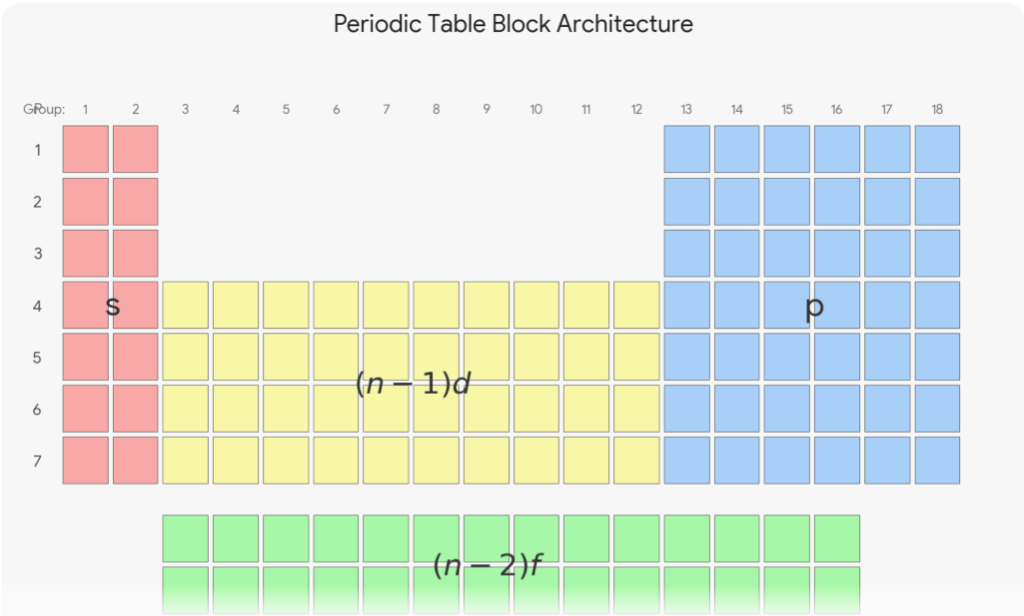
Periodic Table Block Architecture (s, p, d, f)
GroupFamilyValenceChargeKey Characteristic
Group 1Alkali Metalsns¹+1Soft, highly reactive with water.
Group 2Alkaline Earthsns²+2Reactive metals, form basic oxides.
Groups 3–12Transition MetalsVariable+2, +3Lose 4s before 3d; colored solutions.
Group 17Halogensns²np⁵-1Highly reactive nonmetals.
Group 18Noble Gasesns²np⁶0 (Inert)Full stable octet; very high IE₁.

Metals vs. Nonmetals:

• Metals (Left): Low IE₁ and electronegativity; readily form cations.

• Nonmetals (Right): High electronegativity; readily form anions or share electrons.

🎉 CONGRATULATIONS! YOU HAVE COMPLETED THE ENTIRE 28-PAGE COMPANION!