Valence Electrons, Ionic Compounds & Lattice Energy
1. Valence Electrons & The Octet Rule
Valence electrons reside in the outermost occupied principal energy shell ($n$). Because core electrons are locked tightly in filled inner shells, only valence electrons participate in chemical bonding, reactivity, and stoichiometry.
- Group 1: $1$ valence electron ($ns^1$)
- Group 2: $2$ valence electrons ($ns^2$)
- Groups 13–18: $\text{Valence Count} = \text{Group Number} - 10$ ($ns^2 np^1$ through $ns^2 np^6$)
2. Transition Metal Cation Formation: The FIFO Rule
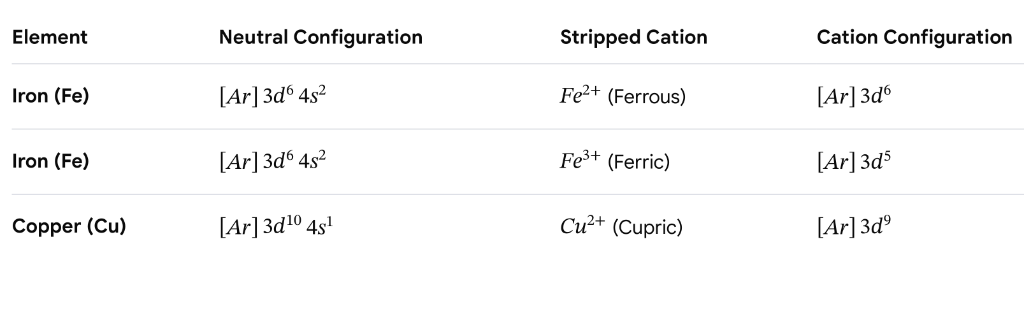
| Element / Ion | Protons ($Z$) | Ground-State Electron Configuration | Key AP Rule Applied |
|---|---|---|---|
| $\text{Fe}$ (Neutral Atom) | 26 | $[Ar] \ 4s^2 3d^6$ | Ground-state Aufbau filling order. |
| $\mathbf{\text{Fe}^{2+}}$ | 26 | $\mathbf{[Ar] \ 3d^6}$ | Loses the two $4s$ electrons first! (Do NOT write $[Ar] 4s^1 3d^5$). |
| $\mathbf{\text{Fe}^{3+}}$ | 26 | $\mathbf{[Ar] \ 3d^5}$ | Loses two $4s$ electrons plus one $3d$ electron. |
| $\mathbf{\text{Cu}^+}$ | 29 | $\mathbf{[Ar] \ 3d^{10}}$ | Loses its single $4s$ electron from neutral $[Ar] 4s^1 3d^{10}$. |
3. The Nature of the Ionic Bond: Lattices vs. Molecules

4. Lattice Energy & Coulomb's Law
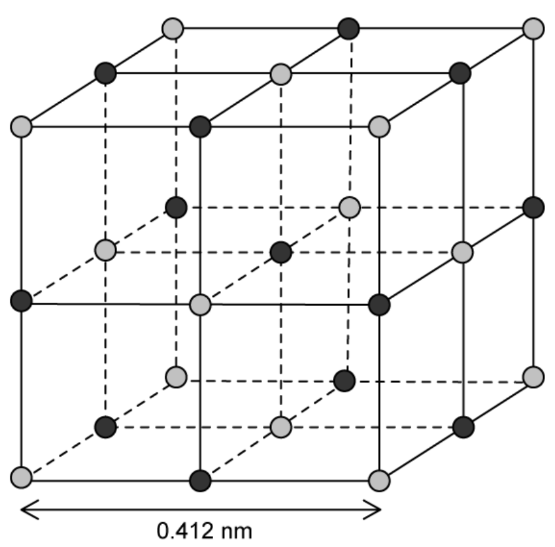
Lattice Energy is the energy released when gaseous ions coalesce into one mole of solid crystalline lattice:
- Step 1: Check Charge Magnitude FIRST ($|q_1 \cdot q_2|$):
Charge product is the supreme factor!
Compare $\text{MgO}$ ($|(+2)(-2)| = 4$) vs. $\text{NaCl}$ ($|(+1)(-1)| = 1$).
$\text{MgO}$ has roughly $4\times$ greater lattice energy and a much higher melting point ($2852^\circ\text{C}$ vs $801^\circ\text{C}$). - Step 2: Check Ionic Radius as a Tiebreaker ONLY ($r$):
When ion charge products are equal (e.g. $\text{NaF}$ vs $\text{NaCl}$ vs $\text{NaBr}$), smaller ions pack closer together (smaller $r$), yielding higher lattice energy:
$\mathbf{\text{NaF} > \text{NaCl} > \text{NaBr}}$
5. Physical Properties of Ionic Solids
- High Melting & Boiling Points: Breaking strong, multidirectional Coulombic attractions throughout the entire 3D crystal lattice demands massive thermal energy.
- Hard and Brittle (Cleavage along planes):
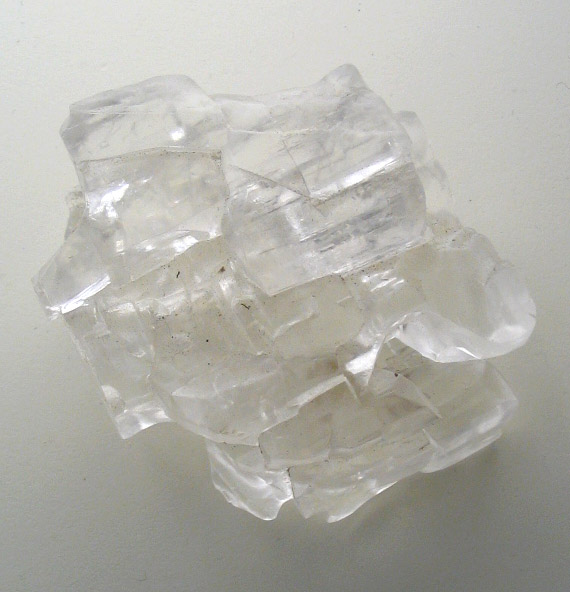
When a shear force impacts an ionic solid, planes of ions shift by one position. This brings like-charges adjacent to one another ($\text{Na}^+$ next to $\text{Na}^+$, $\text{Cl}^-$ next to $\text{Cl}^-$). Intense electrostatic repulsion instantly shatters the crystal along smooth cleavage planes. - Electrical Conductivity:
- Solid state = Nonconductor: Ions are held rigidly in fixed lattice sites and cannot move to carry current.
- Molten (liquid) or Aqueous solution = Excellent conductor: The lattice structure dissociates into mobile cations and anions that migrate freely under an electric field.
6. Worked AP Walkthrough Model
Problem: The melting point of Calcium Oxide ($\text{CaO}$) is $2572^\circ\text{C}$, whereas the melting point of Potassium Fluoride ($\text{KF}$) is $858^\circ\text{C}$. Explain this substantial difference in terms of ion charges and Coulomb's Law, given that $\text{Ca}^{2+}$ and $\text{K}^+$ have similar ionic radii, and $\text{O}^{2-}$ and $\text{F}^-$ have similar ionic radii.
"Both $\text{CaO}$ and $\text{KF}$ form ionic crystalline lattices with comparable internuclear distances ($r$) because the radii of their constituent ions are similar. However, $\text{CaO}$ consists of $\text{Ca}^{2+}$ and $\text{O}^{2-}$ ions, producing a charge product magnitude of $|(+2)(-2)| = 4$. In contrast, $\text{KF}$ consists of $\text{K}^+$ and $\text{F}^-$ ions, producing a charge product magnitude of only $|(+1)(-1)| = 1$. According to Coulomb's Law ($\text{Lattice Energy} \propto \frac{|q_1 q_2|}{r}$), the fourfold increase in the charge product in $\text{CaO}$ generates significantly stronger electrostatic attractions throughout the crystal lattice. Therefore, substantially more thermal energy is required to overcome these attractions, resulting in a much higher melting point for $\text{CaO}$ ($2572^\circ\text{C}$ vs. $858^\circ\text{C}$)."