Photoelectron Spectroscopy, Periodic Trends & Ionic Bonding
⚡ Topic 1.5 Prerequisite Architecture: Orbitals & Periodic Blocks
Slide 1.5 ReviewInterpreting PES spectra (Topic 1.6) and periodic trends (Topic 1.7) builds directly upon orbital filling and periodic block architecture from Topic 1.5:
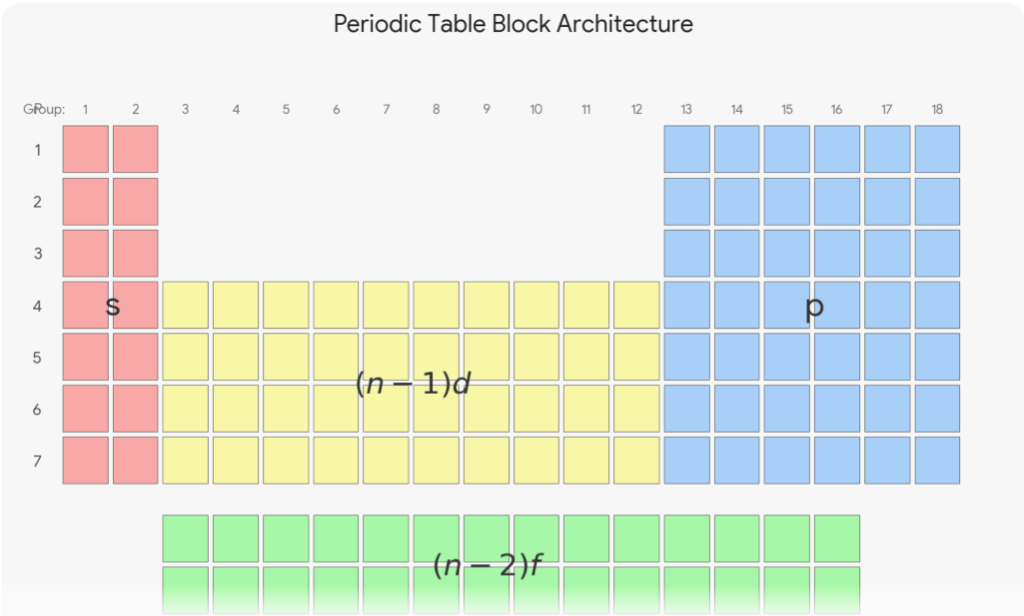
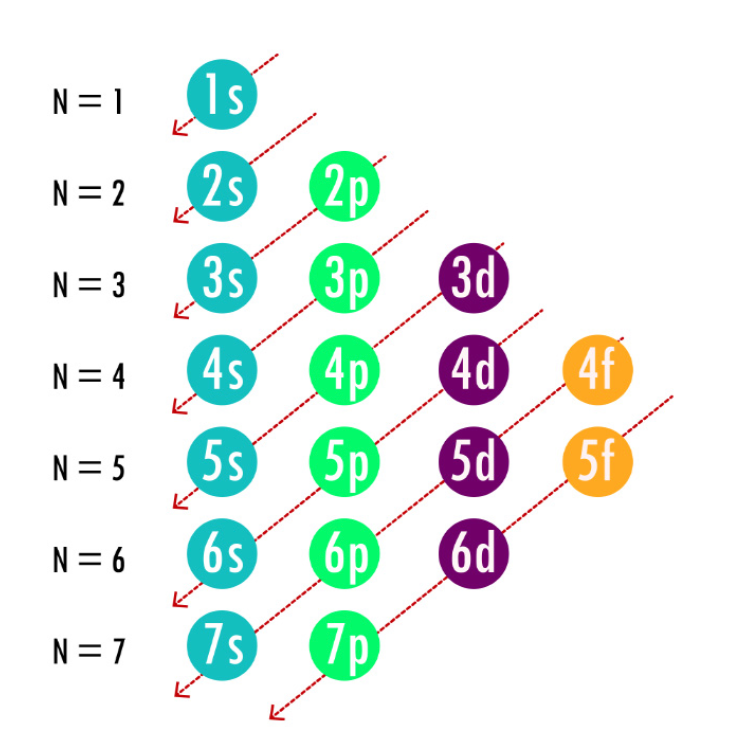
Topic 1.6: Photoelectron Spectroscopy (PES)
Niels Bohr modeled electrons in concentric circular shells ($n = 1, 2, 3$). If the Bohr model were complete, all electrons in shell $n = 2$ would have identical energies. PES experimentally disproved this: $n = 2$ electrons require two distinct ionization energies, proving the existence of $2s$ and $2p$ subshells.
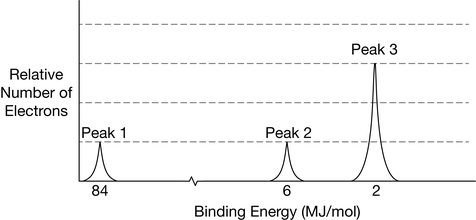
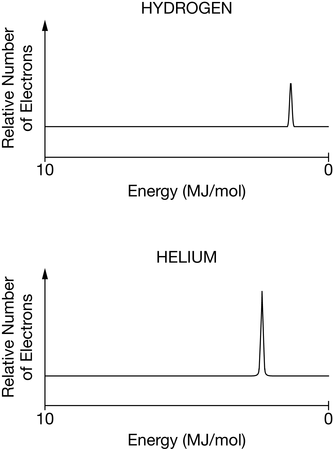
Topic 1.7: Periodic Trends & Coulomb's Law
- Distance ($r$) / Number of Shells: Dominates down a group ($F \propto 1/r^2$).
- Effective Nuclear Charge ($Z_{\text{eff}}$): Dominates across a period ($Z_{\text{eff}} \approx Z - S$).
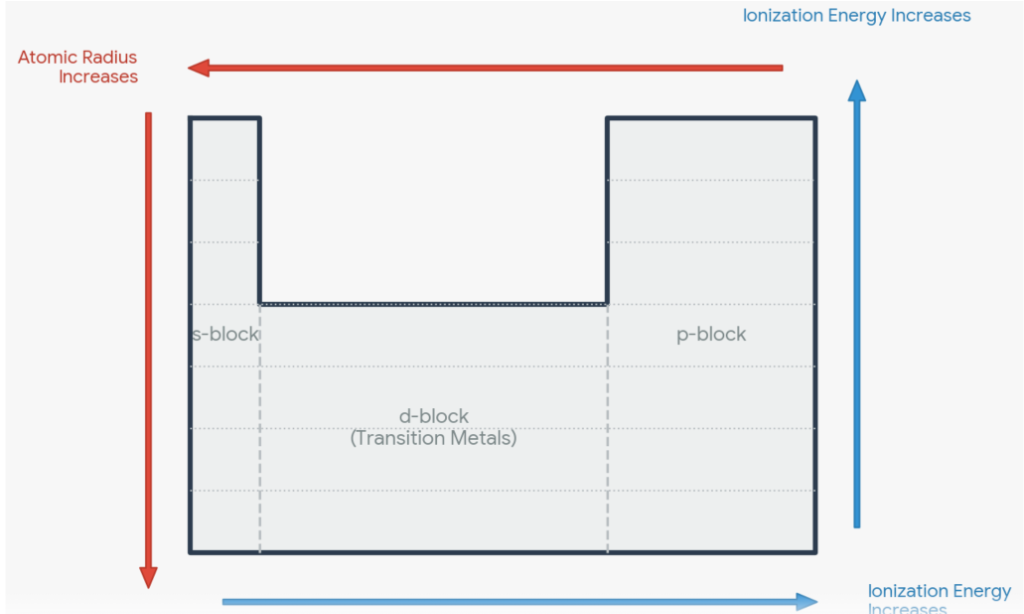

| Periodic Trend | Across a Period ($\rightarrow$) | Down a Group ($\downarrow$) | Coulombic Justification |
|---|---|---|---|
| Atomic Radius | Decreases | Increases | Across: $Z_{\text{eff}}$ increases, pulling shell tighter. Down: Additional energy levels place valence electrons at larger $r$. |
| 1st Ionization Energy | Increases | Decreases | Across: Higher $Z_{\text{eff}}$ binds valence electrons tighter. Down: Greater distance $r$ and core shielding weaken nuclear pull. |
| Electronegativity | Increases (up to F = 4.0) | Decreases | Across: Nucleus draws shared bond pairs closer. Down: Shared electrons are farther from nucleus and shielded. |
| Ionic Radius | Cations < Parent Anions > Parent |
Increases | Cations lose valence shell; reduced repulsion. Anions gain electrons; increased repulsion inflates cloud. |
Topic 1.8: Valence Electrons, Ionic Compounds & Lattice Energy
The Transition Metal FIFO Rule
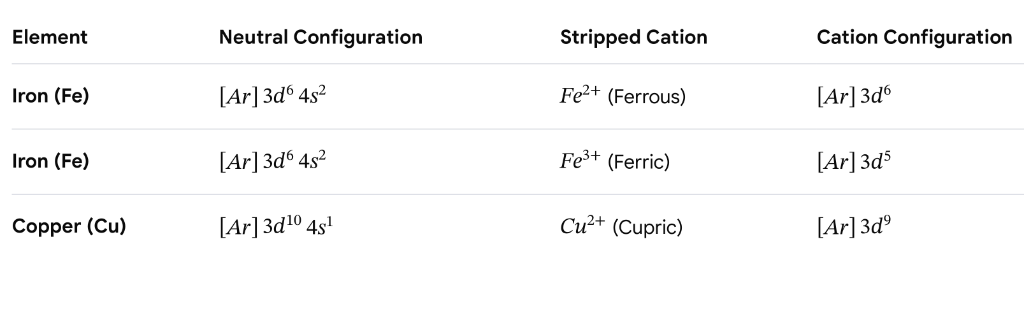
When transition metals form cations, electrons are removed from the highest principal quantum level ($4s$) before $3d$:
- $\text{Fe}: [Ar] 4s^2 3d^6$
- $\text{Fe}^{2+}: [Ar] 3d^6$ (Loses the two 4s electrons!)
- $\text{Fe}^{3+}: [Ar] 3d^5$ (Loses two 4s electrons plus one 3d)

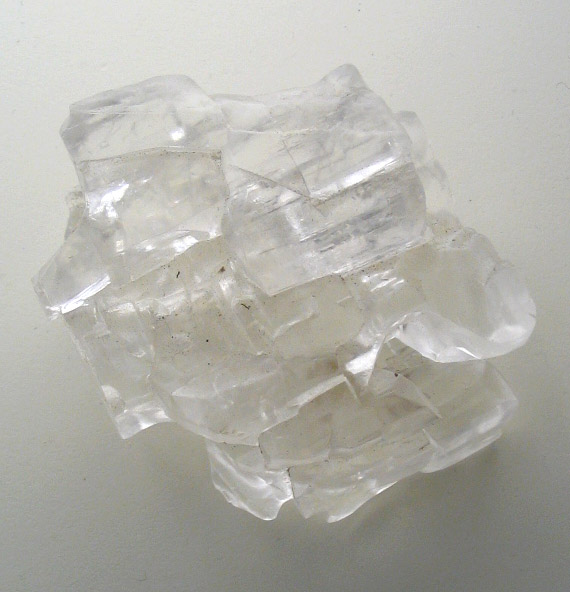
Jeremy Krug's 2-Step Lattice Energy Protocol
- Step 1: Check Charge Magnitude First ($|q_1 \cdot q_2|$): Charge product is KING! $\text{MgO}$ ($|(+2)(-2)| = 4$) has $\approx 4\times$ greater lattice energy and a much higher melting point ($2852^\circ\text{C}$) than $\text{NaCl}$ ($|(+1)(-1)| = 1$, $801^\circ\text{C}$).
- Step 2: Check Ionic Radius as a Tiebreaker Only ($r$): When charges match (e.g. $\text{NaF}$ vs $\text{NaCl}$ vs $\text{NaBr}$), smaller ions pack closer together, yielding stronger lattice energy: $\mathbf{\text{NaF} > \text{NaCl} > \text{NaBr}}$.
Topic 1.6: Photoelectron Spectroscopy (PES) In-Depth
Open Full Standalone 1.6 Guide ↗Monochromatic photons of known energy strike gaseous atoms. Kinetic energy is measured to calculate binding energy: $E_{\text{photon}} = \text{BE} + \text{KE}$.
- Peak Position: Tells which subshell the electrons occupy. $1s$ is always on the far left.
- Peak Height: Proportional to electron count ($s=2, p=6, d=10$).
- Core Shifts: Higher atomic number ($Z$) pulls inner $1s$ electrons tighter, shifting the peak further left ($239\text{ MJ/mol}$ for S vs $178\text{ MJ/mol}$ for Si).
Topic 1.7: Periodic Trends & Coulombic Mechanics
Open Full Standalone 1.7 Guide ↗All trends rely on Coulomb's Law ($F \propto \frac{q_1 q_2}{r^2}$).
The Two Major AP Ionization Energy Anomalies:
- Be vs B: Boron's $2p^1$ electron is in a higher-energy subshell shielded by $2s^2$, so its IE₁ is lower than Beryllium's full $2s^2$.
- N vs O: Oxygen's fourth $2p$ electron must pair up in an orbital ($\uparrow\downarrow \ \uparrow \ \uparrow$). Localized electron-electron repulsion destabilizes it, lowering its IE₁ compared to Nitrogen's half-filled $2p^3$.
Isoelectronic Series:
$\text{O}^{2-} (8p) > \text{F}^- (9p) > \text{Na}^+ (11p) > \text{Mg}^{2+} (12p) > \text{Al}^{3+} (13p)$. More protons with identical shielding = smaller radius.
Topic 1.8: Valence Electrons, Ionic Compounds & Lattice Energy
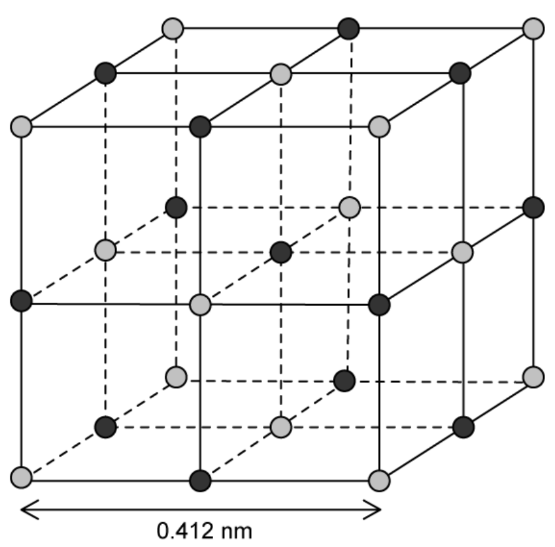
Open Full Standalone 1.8 Guide ↗Ionic solids form continuous 3D lattices. There are NO individual molecules of $\text{NaCl}$.
Physical properties: High melting points due to strong Coulombic attraction; brittle because shear force aligns like charges which repel and cleave; non-conductive as solids but highly conductive when molten or dissolved in water.
12 Complete Worked AP Walkthrough Models
Peaks at $104\text{ MJ/mol}$ (ht 2, $1s^2$), $6.84\text{ MJ/mol}$ (ht 2, $2s^2$), $3.67\text{ MJ/mol}$ (ht 6, $2p^6$), and $0.50\text{ MJ/mol}$ (ht 1, $3s^1$). Total electrons = 11 $\rightarrow$ Sodium ($\text{Na}$).
Both S ($Z = 16$) and Si ($Z = 14$) have two $1s$ electrons. Sulfur has 16 protons vs 14 in Silicon. By Coulomb's Law, the greater nuclear charge in Sulfur holds $1s$ electrons tighter $\rightarrow$ higher binding energy ($239$ vs $178\text{ MJ/mol}$).
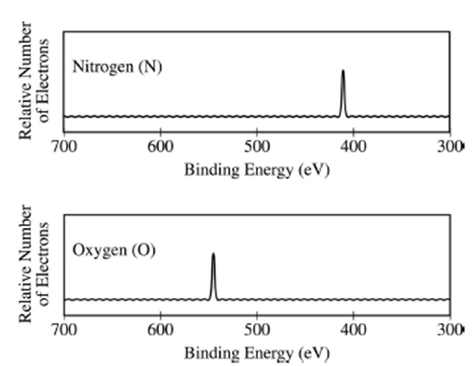
Nitrogen has 7 electrons ($1s^2 2s^2 2p^3$); Oxygen has 8 electrons ($1s^2 2s^2 2p^4$). Oxygen's $2p$ peak is $4/3\times$ taller than Nitrogen's, and all of Oxygen's peaks are shifted to the left (higher binding energy) due to $+1$ proton.
Scandium configuration: $1s^2 2s^2 2p^6 3s^2 3p^6 3d^1 4s^2$. In PES, the $3d$ peak appears to the left of $4s$ (higher binding energy). Once populated, $3d$ electrons are closer to the nucleus on average, which is why $4s$ electrons are ionized first.
From Na to Cl, valence electrons enter the same shell ($n = 3$) with constant core shielding. Nuclear charge increases from $+11$ to $+17$, pulling electrons closer $\rightarrow$ atomic radius decreases.
Ranking: $\mathbf{\text{O}^{2-} > \text{F}^- > \text{Na}^+ > \text{Mg}^{2+} > \text{Al}^{3+}}$. All have 10 electrons. Aluminum has 13 protons exerting the strongest Coulombic pull on the identical electron cloud, producing the smallest radius.
Boron ($2p^1$) has a lower IE₁ than Beryllium ($2s^2$) because the $2p$ subshell is higher in energy and partially shielded by the inner $2s^2$ electrons.
Oxygen has lower IE₁ than Nitrogen because removing an electron from Oxygen relieves localized electron-electron repulsion between the paired electrons in its $2p^4$ orbital.
IE jumps from $4356\text{ kJ/mol}$ ($\text{IE}_4$) to $16091\text{ kJ/mol}$ ($\text{IE}_5$). Giant jump at $\text{IE}_5$ proves 4 valence electrons (Group 14, Period 3 = $\text{Si}$). Compound with chlorine is $\mathbf{\text{SiCl}_4}$.
Neutral Iron ($\text{Fe}$): $[Ar] 4s^2 3d^6$. When forming $\text{Fe}^{2+}$, the two $4s$ electrons are removed first: $\mathbf{\text{Fe}^{2+} = [Ar] 3d^6}$. For $\text{Fe}^{3+}$, an additional $3d$ electron is removed: $\mathbf{\text{Fe}^{3+} = [Ar] 3d^5}$.
$\text{CaO}$ has $+2/-2$ ions ($|q_1 q_2| = 4$) while $\text{KF}$ has $+1/-1$ ions ($|q_1 q_2| = 1$). Fourfold greater charge product results in far stronger lattice energy $\rightarrow$ melting point of $\text{CaO}$ ($2572^\circ\text{C}$) is much higher than $\text{KF}$ ($858^\circ\text{C}$).
Comparing $\text{NaF}, \text{NaCl}, \text{NaBr}$: all have $+1/-1$ charges. Anion radius increases down Group 17 ($\text{F}^- < \text{Cl}^- < \text{Br}^-$). Smaller distance $r$ gives stronger Coulombic attraction: $\mathbf{\text{NaF} > \text{NaCl} > \text{NaBr}}$.
AP Chemistry Trap & Misconception Matrix
| Frequent Exam Mistake | Why It Loses Points | The AP-Accurate Correction |
|---|---|---|
| "IE increases because it's further right." | Table position is not a physical mechanism. | Cite increasing effective nuclear charge ($Z_{\text{eff}}$) pulling on electrons in the same principal energy level. |
| "PES peak height shows electron energy." | Confuses the vertical axis (count) with horizontal (energy). | Peak height represents number of electrons in that subshell. Peak position on x-axis represents binding energy. |
| "NaCl is a molecule." | Ionic solids do not form discrete covalent molecules. | Ionic compounds form continuous 3D crystalline lattices of formula units. |
| "Iron(II) ion is $[Ar] 4s^2 3d^4$." | Fails to apply the FIFO rule. | Electrons in highest principal level ($4s$) are always stripped before $3d$ ($\text{Fe}^{2+} = [Ar] 3d^6$). |
| "Size decides lattice energy before charge." | Charge product ($q_1 q_2$) has far greater mathematical impact than size differences. | Always check ion charge product first ($+2/-2 > +1/-1$). Use radius only as a secondary tiebreaker. |