Periodic Trends & Coulombic Mechanics
1. The Governing Framework: Coulomb's Law
Every single periodic trend on the AP Chemistry Exam must be explained through Coulomb's Law:
Where:
- $q_1 = Z_{\text{eff}}$: Effective nuclear charge experienced by valence electrons ($Z_{\text{eff}} \approx Z - S$).
- $q_2 = -1$: Charge of an electron.
- $r$: Internuclear distance between valence electrons and the nucleus (governed by principal quantum level $n$).
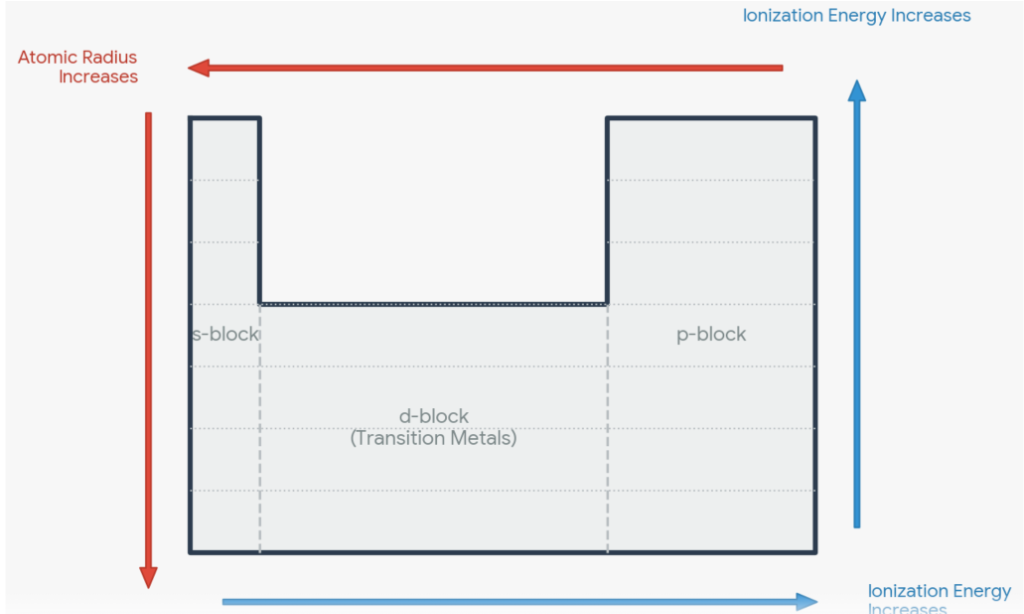
- Down a Group: Distance ($r$) / Number of Shells dominates! Adding energy levels places valence electrons at larger $r$, weakening Coulombic attraction.
- Across a Period: Effective Nuclear Charge ($Z_{\text{eff}}$) dominates! Same shell $n$, constant shielding, but $+1$ proton per step pulls electrons tighter.
2. Atomic Radius & Ionic Radii Trends


Cations vs. Anions: The Coulombic Explanation
- Cations ($+$) are ALWAYS SMALLER than their parent neutral atoms:
When $\text{Na} \rightarrow \text{Na}^+ + e^-$, the entire outer $n = 3$ energy level is lost. With fewer electrons (10 vs 11), electron-electron repulsions decrease, and the 11 protons pull the remaining electrons closer to the nucleus. - Anions ($-$) are ALWAYS LARGER than their parent neutral atoms:
When $\text{Cl} + e^- \rightarrow \text{Cl}^-$, an electron is added to the valence shell. The nuclear charge remains unchanged ($Z = 17$), but localized electron-electron repulsions among the 18 electrons increase, causing the electron cloud to expand outward.
3. The Isoelectronic Series: Radius Controlled by Protons
An isoelectronic series consists of species having the identical number of electrons and ground-state electron configurations.
| Ion / Atom | Protons ($Z$) | Electrons | Configuration | Ionic Radius | Coulombic Justification |
|---|---|---|---|---|---|
| $\mathbf{\text{O}^{2-}}$ | 8 | 10 | $1s^2 2s^2 2p^6$ | 140 pm (Largest) | Fewest protons pulling on 10 electrons $\rightarrow$ weakest Coulombic attraction $\rightarrow$ largest cloud. |
| $\mathbf{\text{F}^-}$ | 9 | 10 | $1s^2 2s^2 2p^6$ | 133 pm | 9 protons pull 10 electrons slightly tighter than in $\text{O}^{2-}$. |
| $\mathbf{\text{Na}^+}$ | 11 | 10 | $1s^2 2s^2 2p^6$ | 102 pm | 11 protons exert substantially stronger pull on 10 electrons. |
| $\mathbf{\text{Mg}^{2+}}$ | 12 | 10 | $1s^2 2s^2 2p^6$ | 72 pm | 12 protons pull 10 electrons even tighter. |
| $\mathbf{\text{Al}^{3+}}$ | 13 | 10 | $1s^2 2s^2 2p^6$ | 54 pm (Smallest) | Most protons (13) with identical core shielding $\rightarrow$ strongest Coulombic attraction $\rightarrow$ smallest cloud. |
4. The Two Essential Ionization Energy Exceptions
Across Period 2 ($\text{Li} \rightarrow \text{Ne}$), First Ionization Energy generally increases. However, there are two distinct drops tested repeatedly on the AP Exam:
Observation: Boron ($801\text{ kJ/mol}$) has a lower 1st IE than Beryllium ($899\text{ kJ/mol}$), despite having one more proton.
AP Justification: Beryllium's electron is removed from a full, stable $2s$ subshell ($1s^2 2s^2$). Boron's electron is removed from the $2p$ subshell ($1s^2 2s^2 2p^1$). The $2p$ subshell is at a higher average energy level and is partially shielded by the $2s^2$ electrons, requiring less energy to ionize.
Observation: Oxygen ($1314\text{ kJ/mol}$) has a lower 1st IE than Nitrogen ($1402\text{ kJ/mol}$), despite higher $Z$.
AP Justification: Nitrogen ($1s^2 2s^2 2p^3$) has each $2p$ orbital singly occupied with parallel spins ($\uparrow \ \uparrow \ \uparrow$). Oxygen ($1s^2 2s^2 2p^4$) has one pair of electrons sharing the same $2p$ orbital ($\uparrow\downarrow \ \uparrow \ \uparrow$). The two electrons sharing an orbital experience localized electron-electron repulsion, which destabilizes the electron and lowers the energy required to remove it.
5. Successive Ionization Energies & Identifying Unknown Elements
When successive electrons are removed from the same atom, a giant leap (typically $4\times$ to $10\times$) occurs as soon as all valence electrons are exhausted and the first core electron is ionized.
| Element | $\text{IE}_1$ | $\text{IE}_2$ | $\text{IE}_3$ | $\text{IE}_4$ | $\text{IE}_5$ | Location of Giant Jump | Valence e⁻ | Group |
|---|---|---|---|---|---|---|---|---|
| Element X | 578 | 1817 | 2745 | 11577 | 14842 | Between $\text{IE}_3$ & $\text{IE}_4$ | 3 | Group 13 ($\text{Al}$) |
| Element Y | 738 | 1451 | 7733 | 10540 | 13630 | Between $\text{IE}_2$ & $\text{IE}_3$ | 2 | Group 2 ($\text{Mg}$) |
6. Worked AP Walkthrough Model
Problem: A Period 3 element exhibits successive ionization energies in $\text{kJ/mol}$ of: $\text{IE}_1 = 786$, $\text{IE}_2 = 1577$, $\text{IE}_3 = 3232$, $\text{IE}_4 = 4356$, $\mathbf{\text{IE}_5 = 16091}$. Deduce the identity of the element and write the formula of its compound with Fluorine.
- Identify Jump: The massive increase occurs between $\text{IE}_4$ and $\text{IE}_5$ ($4356 \rightarrow 16091\text{ kJ/mol}$, nearly a $4\times$ leap).
- Valence Count: Removing the 5th electron breaks into the stable inner core shell ($n = 2$). Thus, the atom has exactly 4 valence electrons.
- Element Identity: The Period 3 element with 4 valence electrons (Group 14) is Silicon ($\text{Si}$).
- Compound Formula: Silicon shares 4 valence electrons with 4 Fluorine atoms to form $\mathbf{\text{SiF}_4}$.